Bridging the Past and the Future
Imagine you are an architect standing before a magnificent historic palace. In your hands, you hold a set of yellowed, 19th-century plans—beautifully drawn, yet inaccurate and incomplete. Renovations, settlements, and the simple passage of time have created a vast gap between these documents and the building’s current reality. This is the daily complexity that professionals in heritage preservation and restoration must navigate.
While Building Information Modeling (BIM) has become the standard for new construction, a specialized methodology provides the answer for historic buildings: Heritage Building Information Modeling (HBIM). HBIM is not just a technological upgrade; it is a revolutionary approach that precisely captures the past to sustainably plan for the future.
The Client’s Challenge: Operating in Uncertainty
Every project manager, engineer, or architect who has worked on a historic building knows the typical problems that arise from relying on outdated 2D data.
- Incomplete Information: Existing plans are often full of gaps and fail to represent the building’s true as-is condition—including deformations, unforeseen material changes, and later additions.
- Hidden Risks: What lies behind the ornate plaster ceiling or within the foundation? Without an accurate digital survey, costly surprises during the construction phase are almost inevitable.
- High Risk of Errors: Manual measurements are time-consuming and prone to error. Planning mistakes based on inaccurate data invariably lead to budget overruns and project delays.
These uncertainties turn restoration into a high-stakes gamble.
The Power of the Point Cloud: Precision as the Foundation
The solution begins with a perfect data foundation. Modern surveying methods like laser scanning and photogrammetry generate a point cloud—a collection of millions of measurement points that capture the building’s entire geometry with millimeter-level precision.
The advantages are decisive:
- Millimeter-Accurate Reality: The point cloud captures the exact as-is state, including all irregularities, deformations, and details.
- The Digital Twin: This data is the basis for a true digital twin—a virtual replica of the building that serves as a reliable “single source of truth” for all project stakeholders.
- On-Site Efficiency: The need for repeated site visits by architects, engineers, and surveyors is drastically reduced, as all relevant information is available digitally.
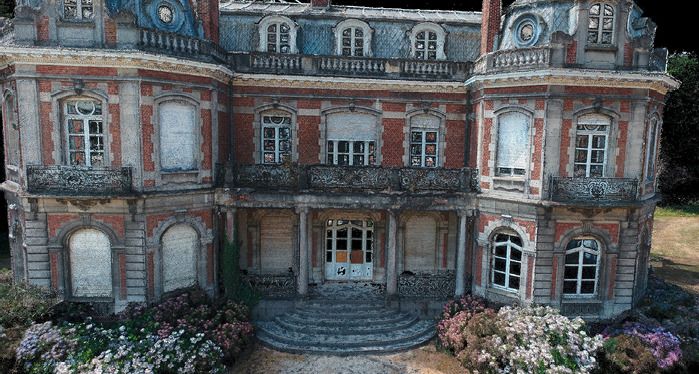
Our BIM Process: From Point Cloud to Intelligent HBIM Model
A point cloud alone is just raw geometric data. Its true value is unlocked through our specialized engineering services that transform this data into an intelligent HBIM model.
Our proven workflow is as follows:
- Data Reception: You or your surveyor provide us with the high-precision point cloud of the property.
- Modeling in Revit: Our specialists use leading software like Autodesk Revit to create a precise 3D as-built model from the millions of points. Historic building components such as vaults, cornices, or timber frames are modeled with high fidelity.
- Intelligent Data Integration: This is the crucial step. We convert the 3D model into an intelligent BIM model by enriching components with information. This includes classifying materials, documenting structural damage, assigning construction phases, or cataloging protected historical elements.
The result is a reliable, data-rich foundation for all further planning, analysis, and sustainable heritage management.
2D Plan vs. 3D Model: A Direct Comparison
The practical difference is enormous. Let’s compare three typical project tasks to provide a unique insight that goes beyond rehashing existing material.
| Task | Limitation with a 2D Plan | Advantage with a 3D HBIM Model |
| 1. Installing a New Door | Requires manual measurements and assumptions about wall composition and thickness. The risk of hitting a load-bearing element or historic feature is high. | The model shows the exact wall structure, materials, and hidden utilities. A clash detection is run digitally before the first cut is made. |
| 2. Assessing Structural Integrity | A crack on a drawing is just a line. Its structural significance remains unclear without costly, invasive investigations. | The crack is visualized in the 3D model. An engineer can analyze deformation patterns, run load simulations, and assess its impact on the entire structure. |
| 3. Integrating Modern HVAC | Planning duct routes is a guessing game of trying to avoid historic stucco, frescoes, and structural beams—often resulting in compromises. | In the digital twin, the routing is planned with precision and free of clashes. The path is optimized to ensure maximum preservation of the historic fabric. |

Success Stories: Building Authority Through Proven Results
The transformative power of HBIM is not theoretical; it is proven practice in some of the world’s most demanding restoration projects.
- Notre-Dame de Paris: After the devastating fire in 2019, laser scans taken years earlier formed the invaluable basis for the reconstruction. The existing point cloud and the resulting HBIM model allowed architects and engineers to accurately rebuild the complex Gothic structure.
- Glasgow School of Art: Following a fire that destroyed the famous Mackintosh building, a detailed HBIM model was also central to its restoration. It served as a precise blueprint for faithfully recreating the unique architectural details.
Conclusion and Your Next Step
Investing in a professional HBIM model is not an expense; it is a strategic decision for the long-term success of your project. It minimizes risks, prevents unforeseen costs, and ensures the respectful and precise restoration of our cultural heritage. An intelligent as-built model is the foundation upon which all successful planning for historic buildings is built.
Are you an architect, engineer, or project manager facing the complexity of a heritage preservation project?
Contact us today. Let us show you how our specialized engineering services can transform your point cloud into a powerful and intelligent HBIM model. Together, let’s build the future while preserving the past.
 construct-era
Leave a comment